 Prague Jewish Quarter Tours
Pinkas Synagogue Prague: the Memorial Walls and the Children's Drawings
The Pinkas Synagogue in Prague's Josefov district is the memorial to the Jewish victims of the Shoah from Bohemia and Moravia. Its walls carry the written names of the victims, 77,297 by one count and nearly 80,000 by the museum's, and the gallery upstairs shows 4,387 drawings made by children in the Terezin ghetto between 1942 and 1944. This guide covers what the memorial is, who painted it, why the building was closed and reopened, the drawings and the rule about silence inside, plus the ticket, the opening hours and the route from the synagogue into the Old Jewish Cemetery. Entry comes on the Jewish Quarter Ticket, or on Prague Jewish Quarter tours that include admission. The facts below come from the Jewish Museum in Prague, its visitor regulations and Wikipedia.
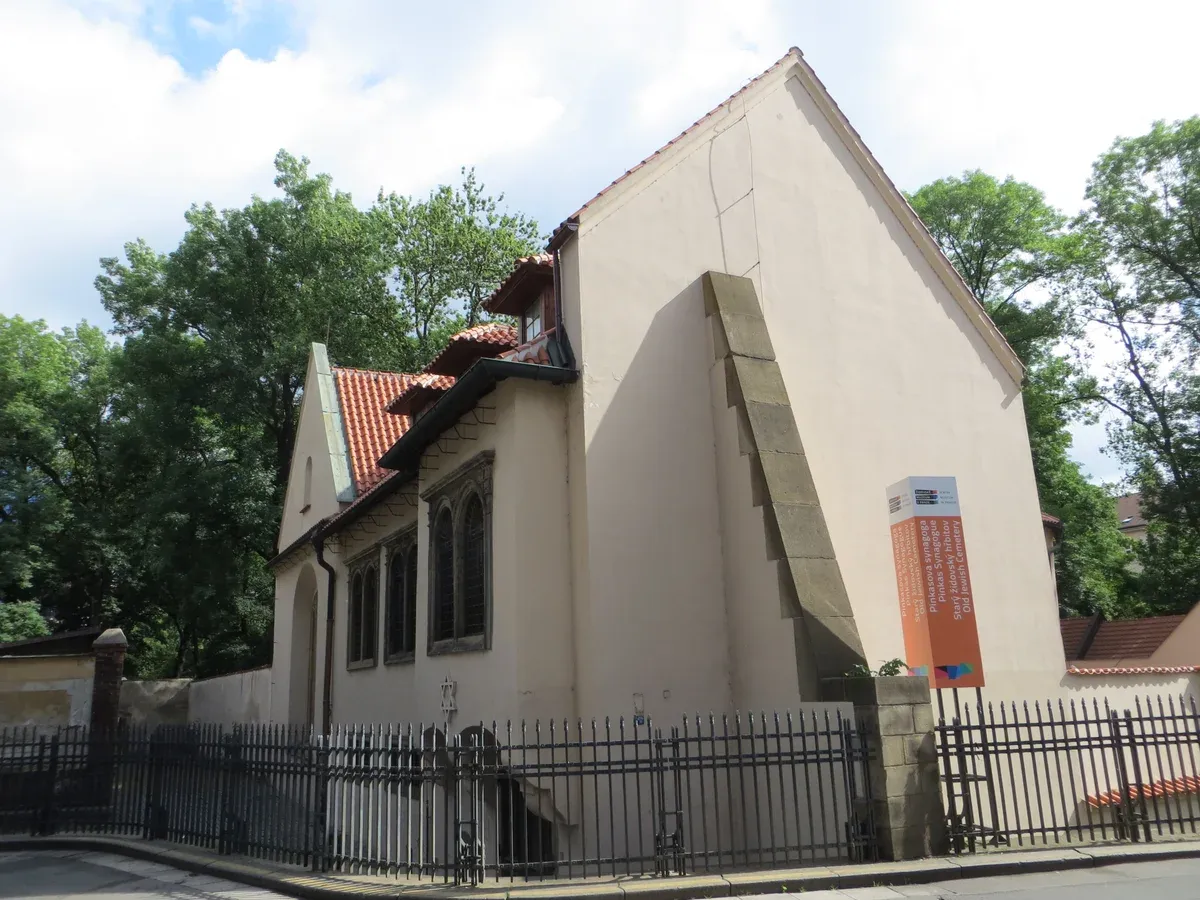
The Pinkas Synagogue seen from the street. Photo: Mister No, CC BY 3.0, via Wikimedia Commons
Quick answer The Pinkas Synagogue in short
The Pinkas Synagogue is Prague's memorial to the Jewish victims of the Shoah from Bohemia and Moravia, 77,297 names by one count and nearly 80,000 by the museum's, written on the walls between 1955 and 1960. Built in 1535, it is the second oldest surviving synagogue in Prague. Upstairs hang 4,387 drawings made by children in the Terezin ghetto. It stands at Široká 3, the same address as the Old Jewish Cemetery entrance.
Key takeaways
- Entry is on the Jewish Quarter Ticket, which also covers the Old Jewish Cemetery next door.
- See the guided walk with all five admissions at $74 per person if you want the memorial explained in context.
- Loud conversation and commentary are not allowed inside, so plan to read the names quietly.
- The children's drawings from Terezin are on the first floor and entered the UNESCO Memory of the World Register.
The Memorial Walls
The interior of the Pinkas Synagogue is a written list of the dead. The walls carry the names.
Who the Names Are and How Many
The walls name the Jewish victims of the Shoah from Bohemia and Moravia. Wikipedia counts nearly 80,000 names on the walls. The Jewish Museum describes the memorial as naming nearly 80,000 victims. Both figures describe the same memorial.
A digital database at the site lets visitors look up a victim's name, portrait and the exact wall location where that name is painted. If you are searching for a family name, the database is the fastest way to find it among the names rather than scanning wall after wall.
- About 77,297 names painted on the interior walls (Wikipedia figure)
- Nearly 80,000 victims named, per the Jewish Museum
- A digital database gives each name's wall location
The Painters and the Years
The memorial was made by the painters Václav Boštík and Jiří John. They worked on it from 1955 to 1960, and the memorial opened in 1960. Names, not numbers, are the point of the room.
- Painted by Václav Boštík and Jiří John
- Work ran from 1955 to 1960
- The memorial opened in 1960
Silence Inside
The museum's visitor regulations state that loud conversation and commentary are not allowed inside the Pinkas Synagogue. The rule is part of how the building works as a memorial, so visitors read the names quietly. Photography for personal use is allowed without flash, tripods, selfie sticks or extra lighting, and the security check on entry applies here as at the other museum sites.
Sources: Jewish Museum in Prague, Wikipedia
The Children's Drawings From Terezin
The first floor gallery of the Pinkas Synagogue holds the drawings made by children imprisoned in the Terezin ghetto during the Second World War.
What Is on the First Floor
The Jewish Museum counts 4,387 drawings by children in Theresienstadt, the ghetto that the Germans called Theresienstadt, now Terezin, which lies about 60 to 70 km north of Prague depending on the source. Wikipedia's article gives about 4,500. The museum's figure of 4,387 is the count entered in the UNESCO Memory of the World Register, which the drawings joined.
The drawings on display come from 1942 to 1944. More than 10,000 children under 15 passed through Theresienstadt.
- 4,387 drawings per the museum, about 4,500 per Wikipedia
- Made in Theresienstadt between 1942 and 1944
- UNESCO Memory of the World Register since 2025
Friedl Dicker-Brandeis and the Lessons
The drawings come from lessons led by Friedl Dicker-Brandeis. For background on the ghetto itself, its transports and its liberation on 8 May 1945, see the guide to Terezin concentration camp.
Sources: Jewish Museum in Prague
History of the Building
The Pinkas Synagogue has been a house of prayer, a memorial and a flood-damaged building under repair. The table gives the dates in order, drawn from the Jewish Museum and Wikipedia.
From 1535 to the Memorial
Aaron Meshullam Horowitz built the synagogue for the Horovitz family and it was completed in 1535 in late Gothic style, which makes it the second oldest surviving synagogue in Prague. A small house of worship already stood on the site in 1492. The reticulated vault is late Gothic, while its ornaments carry Renaissance features.
The women's gallery, the vestibule and the entrance were added in the early 17th century, and a Renaissance annex designed by Juda Coref de Herz followed between 1607 and 1625. In 1793 Joachim von Popper donated the Rococo wrought-iron grille. Floods shaped the building too: the floor was raised 1.5 metres after flood damage in 1860.
In 1950 to 1954 the original floor level and appearance were restored, which prepared the building for the memorial that Boštík and John painted from 1955 to 1960.
Closure and Reopening
The two sources give slightly different closure dates. Wikipedia records that the memorial opened in 1960, closed in 1968 and reopened in 1989 after reconstruction. The Jewish Museum records a closure from 1968 to 1995 and a reopening in 2003 after flood repairs.
In the 2002 flooding the nave stood 1.3 metres deep in water, and the repairs that followed kept the building shut until 2003. Wikipedia gives moisture as the reason for the 1968 closure. An evening video-mapping projection of victims' photographs is shown on the mikveh, except on Fridays and Jewish holidays.
| Year | What happened |
|---|---|
| 1492 | A small house of worship stood on the site |
| 1535 | Building completed for the Horovitz family in late Gothic style |
| 1607-1625 | Renaissance annex by Juda Coref de Herz, with the women's gallery and vestibule added in the early 17th century |
| 1793 | Rococo wrought-iron grille donated by Joachim von Popper |
| 1860 | Floor raised 1.5 metres after flood damage |
| 1950-1954 | Original floor level and appearance restored |
| 1955-1960 | Memorial painted by Václav Boštík and Jiří John, opened 1960 |
| 1968 | Closed. The museum gives 1968-1995 for the building, Wikipedia 1968-1989 for the memorial |
| 2002 | Flooding left the nave 1.3 metres deep |
| 2003 | Reopened after flood repairs, per the museum |
Sources: Jewish Museum in Prague, Wikipedia
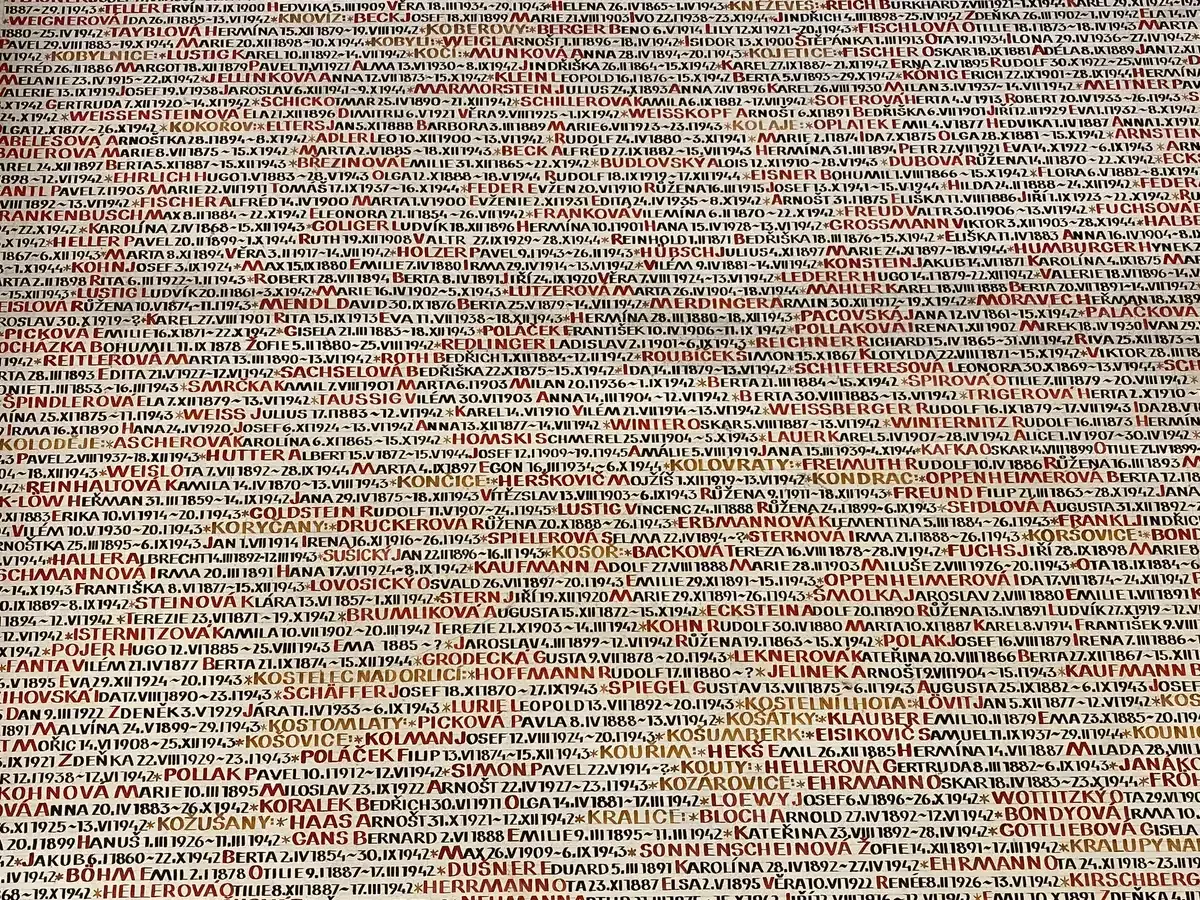
Names of Holocaust victims from the Czech lands on the inner wall of the synagogue. Photo: Saifunny, CC BY-SA 4.0, via Wikimedia Commons
Visiting
The Pinkas Synagogue stands at Široká 3 in Josefov. One ticket covers it, the other museum sites and the Old Jewish Cemetery, and it is closed on Saturdays and Jewish holidays.
The Ticket
The Pinkas Synagogue is part of the Jewish Museum circuit and entry comes on the ticket sold as the Jewish Quarter Ticket, either bought directly or included on tours such as the 2.5-hour guided walk with admission. One ticket covers all currently open sites, which are the Maisel, Pinkas, Spanish and Old-New Synagogues plus the Old Jewish Cemetery, with the Klausen Synagogue partly open for temporary exhibitions. The museum's own tickets for individuals and families are valid for three days, while the Jewish Quarter Ticket sold here is valid for 1 day.
Each visitor site may be entered only once per ticket. Tickets are sold online, at the Visitor Centre at Maiselova 15, and at the counters of the Spanish, Klausen, Pinkas and Maisel Synagogues. Sales end 30 minutes before closing time.
Children under 15 must be with an adult, and Prague Visitor Pass and Prague CoolPass holders enter free. Audio guides are rented at the Visitor Centre, at the Pinkas Synagogue entrance and at the Old Jewish Cemetery entrance, run about two hours with 80 stops, and come in Hebrew, English, German, Spanish, Italian and French. The museum puts a complete circuit tour at roughly 2 to 3 hours.
Tickets are non-refundable and a lost ticket is not replaced.
Hours and Quiet Times
The museum opens daily except Saturdays and Jewish holidays. In 2026 the hours run 9:00-16:30 from 2 January to 31 March, 9:00-18:00 in April, 9:00-19:00 from 1 May to 31 August, 9:00-18:00 from 1 September to 17 October, and 9:00-16:30 from 18 October to 31 December. On 1 January the sites open 11:00-16:30 and on 24 December they close at 14:00.
Entry is guaranteed up to 30 minutes before closing and visitors are ushered out 10 minutes before. The museum also closes for the main Jewish holidays, including Pesach, Shavuot, Rosh Hashanah, Yom Kippur, Sukkot and Shemini Atzeret. Check both the visitor rules and the hours page before you go, because the two sources differ on some second-day holidays.
The museum advises avoiding the 11:00-15:00 peak, since mornings and late afternoons are much quieter.
Rules and Getting There
Loud conversation and commentary are not allowed inside the Pinkas Synagogue, so read the walls quietly and let the names speak. Bags over 30 litres are refused at the entrance and the museum has no luggage storage. Exposed arms, shoulders or midriff, swimwear and bare feet are not allowed.
Food, drinks and smoking are banned, dogs are banned except certified assistance dogs, and personal photos and video are allowed without flash, tripod, selfie stick or extra lighting. Security checks apply on entry. Staroměstská on Metro Line A is a 3-minute walk from the museum, with trams 17 and 18 and buses 194 and 207 stopping there.
Old Town Square is 5 minutes on foot and Charles Bridge 10 minutes. The nearest paid parking is below Čechův most on nábřeží Edvarda Beneše, and the museum advises leaving the car outside the centre.
The Route on Into the Cemetery
The Old Jewish Cemetery entrance is at Široká 3, the same address as the synagogue. The cemetery was in use from 1439 and its last burial was in 1787. It holds more than 12,000 tombstones Men must cover their heads on entering, with their own covering or a borrowed one, and visitors may walk only the marked route.
The cemetery's history, its famous graves and the burial layers are covered in full in the guide to the Old Jewish Cemetery.
Sources: Jewish Museum in Prague, visitor regulations, opening hours
Frequently Asked Questions
How many names are on the walls of the Pinkas Synagogue?
Wikipedia counts nearly 80,000 names of Bohemian and Moravian Jewish victims of the Shoah painted on the walls, while the Jewish Museum describes the memorial as naming nearly 80,000 victims. The digital database at the site gives each name's exact wall location.
Who painted the memorial in the Pinkas Synagogue?
The painters Václav Boštík and Jiří John painted the memorial between 1955 and 1960, and it opened in 1960. Loud commentary is not allowed inside.
Why was the Pinkas Synagogue closed for so long?
The sources differ. Wikipedia records a closure from 1968 and a reopening in 1989 after reconstruction, while the Jewish Museum records the building closed from 1968 to 1995 and reopened in 2003 after the 2002 flood left the nave 1.3 metres deep. Both accounts appear in the history section.
What are the children's drawings in the Pinkas Synagogue?
The first floor holds 4,387 drawings made by children in the Theresienstadt ghetto between 1942 and 1944, from lessons led by Friedl Dicker-Brandeis, and Wikipedia gives the count as about 4,500. They joined the UNESCO Memory of the World Register. More on the ghetto itself is in the Terezin guide.
How much does it cost to visit the Pinkas Synagogue?
Entry comes on the Jewish Quarter Ticket, which covers the Pinkas Synagogue, the other synagogues of the circuit and the Old Jewish Cemetery. The museum's own tickets for individuals and families are valid for three days, while the Jewish Quarter Ticket sold here is valid for 1 day.
Is the Pinkas Synagogue open on Saturdays?
No. The Jewish Museum sites open daily except Saturdays and Jewish holidays, such as Pesach, Rosh Hashanah, Yom Kippur and Sukkot. The full hours and closures are listed above.