 Prague Jewish Quarter Tours
The Kafka Statue in Prague: What It Shows and Where to Find It
The Kafka statue in Prague stands on Dušní street in Josefov, between the Spanish Synagogue and the Church of the Holy Spirit. This page covers the bronze monument by Jaroslav Róna, what it depicts from Description of a Struggle, and the other Kafka sites: the site of his birth house at Franz Kafka Square and his grave in the New Jewish Cemetery in Žižkov. If you want the statue explained as part of the wider quarter, the guided Prague Jewish Quarter tours on this site cover the quarter around it, and some go inside the Spanish Synagogue next door.
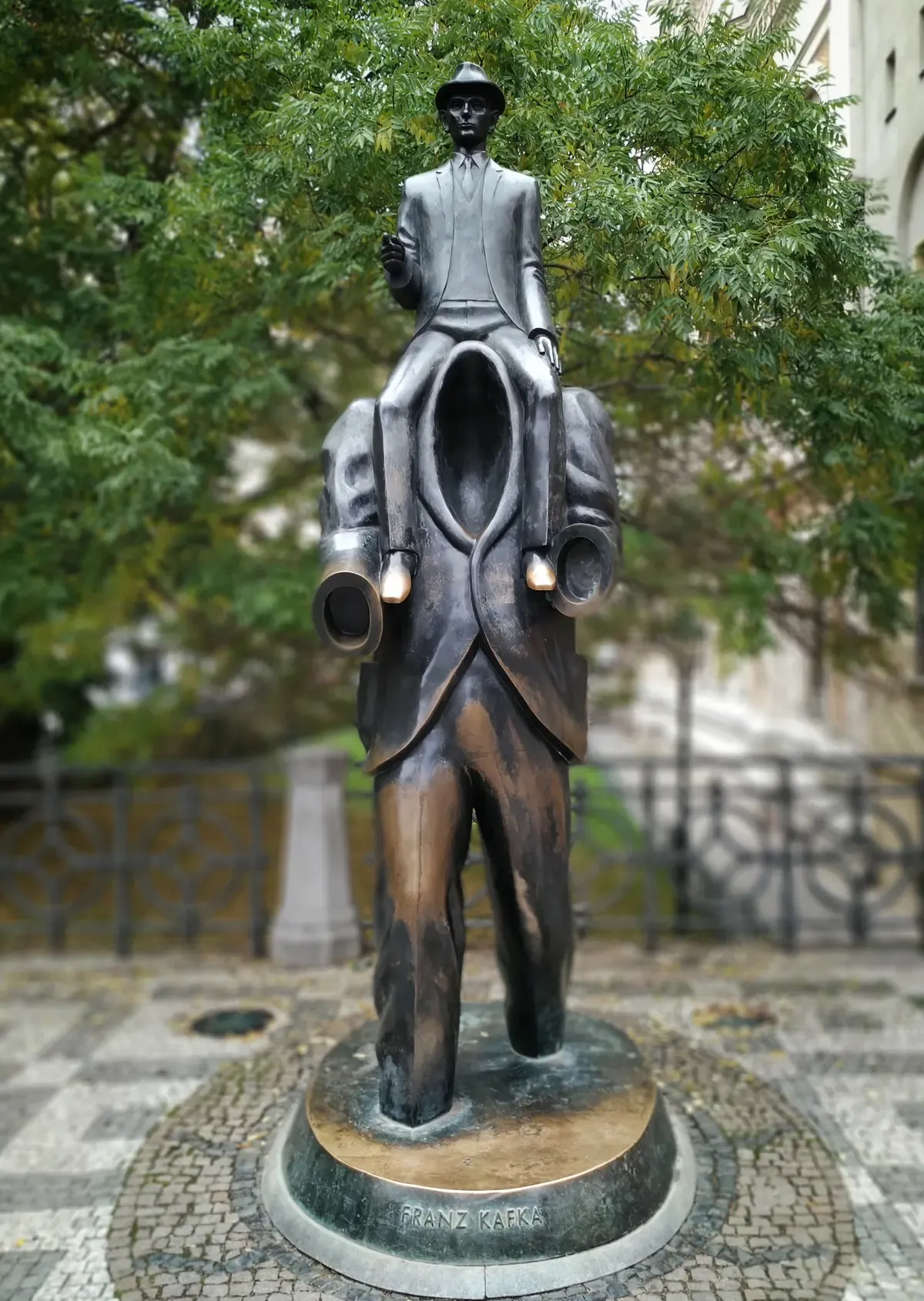
The bronze Franz Kafka statue on Dusni street. Photo: luonan, CC BY 3.0, via Wikimedia Commons
Quick answer The short answer
The Franz Kafka statue in Prague is a bronze figure 375 cm tall, installed in December 2003 on Dušní street in Josefov, between the Spanish Synagogue and the Church of the Holy Spirit. The sculptor is Jaroslav Róna. It shows Kafka riding on the shoulders of a headless giant, a scene from his 1912 story Description of a Struggle. The statue is free to see at any hour, since it stands in the open street.
Key takeaways
- The statue sits at the corner of Dušní and Vězeňská, a few steps from the Spanish Synagogue, itself built in 1868.
- The Jewish Quarter Tour with Tickets enters the Spanish Synagogue beside the statue and costs $74 per person for 2.5 hours.
- Kafka is buried in the New Jewish Cemetery at Izraelská 1 in Žižkov, free to enter and closed on Saturdays.
- See the Prague Jewish Quarter map to plan a walking route that includes the statue, Franz Kafka Square and the museum sites.
The Statue on Dušní Street
A bronze of a writer on a headless figure's shoulders. Here is what it is and why it is there.
What the Statue Shows
The monument shows Franz Kafka on the shoulders of a headless figure. The image comes from Description of a Struggle, the story Kafka wrote in 1912. The sculptor Jaroslav Róna made the work, and his own site dates the Franz Kafka Monument to 2003. It is cast in bronze and stands 375 cm tall.
People often ask why Prague has a Kafka statue at all. The plain answer is that Kafka was born on 3 July 1883 near Old Town Square into a German-speaking Jewish family, studied at the German gymnasium in the Kinský Palace on Old Town Square, passed his Matura in 1901 and earned a law doctorate on 18 June 1906. He died on 3 June 1924 in a sanatorium at Kierling near Vienna, aged 40. A statue of him belongs here because this is the city where he was born and studied.
Where Exactly to Find It
The statue stands at the corner of Dušní and Vězeňská streets in Josefov, between the Spanish Synagogue and the Church of the Holy Spirit. The Spanish Synagogue is on Dušní street. The Old-New Synagogue and the other Jewish Museum sites sit a few minutes' walk away, and Old Town Square is close too. Staroměstská, on Metro Line A and tram lines 17 and 18, is the nearest public transport stop for the wider quarter.
There is no ticket, gate or opening hour. The statue is a public monument on a street corner, free to see at any time of day. It combines easily with a visit to the Spanish Synagogue next door, which hosts the exhibition on Jews in the Bohemian Lands in the 19th and 20th centuries and presents Kafka alongside Sigmund Freud and Gustav Mahler. The synagogue visit is covered on its own page, Spanish Synagogue Prague. The Old-New Synagogue is also a few minutes' walk from Old Town Square.
Which Statue This Page Covers
This page covers the Róna monument at Dušní and Vězeňská in Josefov, next to the Spanish Synagogue. Check any address before you set out, so you end up at the right corner.
Kafka's Josefov
Four Kafka sites in different parts of Prague. The table gathers the addresses and what each place holds, from the sources listed.
The Four Kafka Stops Compared
The table lists each Kafka-related place, its address or area, and what you actually find there. Figures come from the sculptor's page, the cemetery listing and the museum references. The museum is in Malá Strana and the grave is in Žižkov, so each needs a separate trip.
| Place | Address or area | What is there |
|---|---|---|
| Franz Kafka Monument | Dušní and Vězeňská, Josefov | Bronze statue by Jaroslav Róna, 375 cm, installed December 2003, free to see |
| Franz Kafka Square | Náměstí Franze Kafky 1 | The replacement house on the site of his demolished birth home, square renamed in 2000 |
| Kafka's grave | New Jewish Cemetery, Izraelská 1, Prague 3, Žižkov | Tombstone designed by architect Leopold Ehrmann, free admission |
| Franz Kafka Museum | Herget Brickworks, Malá Strana | Museum dedicated to Kafka, opened in summer 2005 |
Franz Kafka Square
Kafka was born near Old Town Square, and the house of his birth was demolished in 1897. The building that replaced it stands at Náměstí Franze Kafky 1, and the square was renamed Franz Kafka Square in 2000. Do not count on a museum inside this stop.
It is best folded into a longer walk through the quarter rather than treated as a destination of its own.
How to Walk It
A simple route covers the statue and the nearby sites and leaves out the museum and the grave. Start at Staroměstská, served by Metro Line A and tram lines 17 and 18. The statue is at Dušní and Vězeňská, with the Spanish Synagogue beside it. The Old-New Synagogue is a few minutes' walk from Old Town Square. The Jewish Museum advises leaving the car outside the centre, and all museum tickets are sold at the Visitor Centre at Maiselova 15.
For the cemetery you need transport out to Žižkov, so plan it as a separate trip, with the grave as the last stop. If you would rather have the quarter explained as you go, Jewish Quarter tours in Prague cover the same ground with a guide, and the Old Jewish Cemetery guide page explains the older burial ground in Josefov.
Kafka's Grave at the New Jewish Cemetery
Kafka was buried in Žižkov, not in Josefov. Here is how to reach the grave and when the cemetery is open.
Practical Details
Kafka was buried on 11 June 1924 in the New Jewish Cemetery in Žižkov. The address is Izraelská 1, Prague 3. Admission is free.
Opening hours are seasonal. From April to October the cemetery is open Sunday to Thursday, 9:00 to 17:00. From November to March the same days run 9:00 to 16:00. On Fridays it opens 9:00 to 14:00. It is closed on Saturdays and Jewish holidays, so plan the grave for a weekday.
What You Will See
The cemetery was founded in 1890 and officially opened on 6 July that year, with the first burial two days earlier. It covers over 10 hectares, was designed to be ten times bigger than the Old Jewish Cemetery in Josefov, and holds about 25,000 burials, with around 25,000 gravestones surviving, mostly in Art Nouveau style. Styles run from Neo-Gothic to Constructivism. It was declared a cultural monument in 1964 and is still in use today.
Kafka's tombstone was designed by the architect Leopold Ehrmann. Poet Ota Pavel is buried here too, along with Jiří Orten, Arnošt Lustig, Lenka Reinerová, Julius and Otto Petschek, Jindřich Waldes and Vilém Flusser. A Holocaust memorial from 1985 stands on the grounds. Take your time. This is a working burial ground, not a museum set, so keep quiet and show respect.
Combining Grave and Quarter in One Day
The grave is in Žižkov and the quarter is in the centre, so split the day. Spend the morning in Josefov with the statue and the synagogues, then head out to Žižkov after lunch and respect the Friday 14:00 closing if your day falls at the end of the week. The Prague metro runs from about 4-5 am until midnight, with trains every 2-3 minutes at rush hour and every 4-10 minutes otherwise, so the trip is easy to fit around the cemetery's hours.
If you would rather not navigate alone, several Prague Jewish Quarter tours cover the quarter's sites with admission built in, and you can add the cemetery on your own afterward. The Jewish Museum Prague page explains which ticket covers which sites before you choose.
Sources: Synagogue.cz: New Jewish Cemetery, Wikipedia: New Jewish Cemetery, Prague
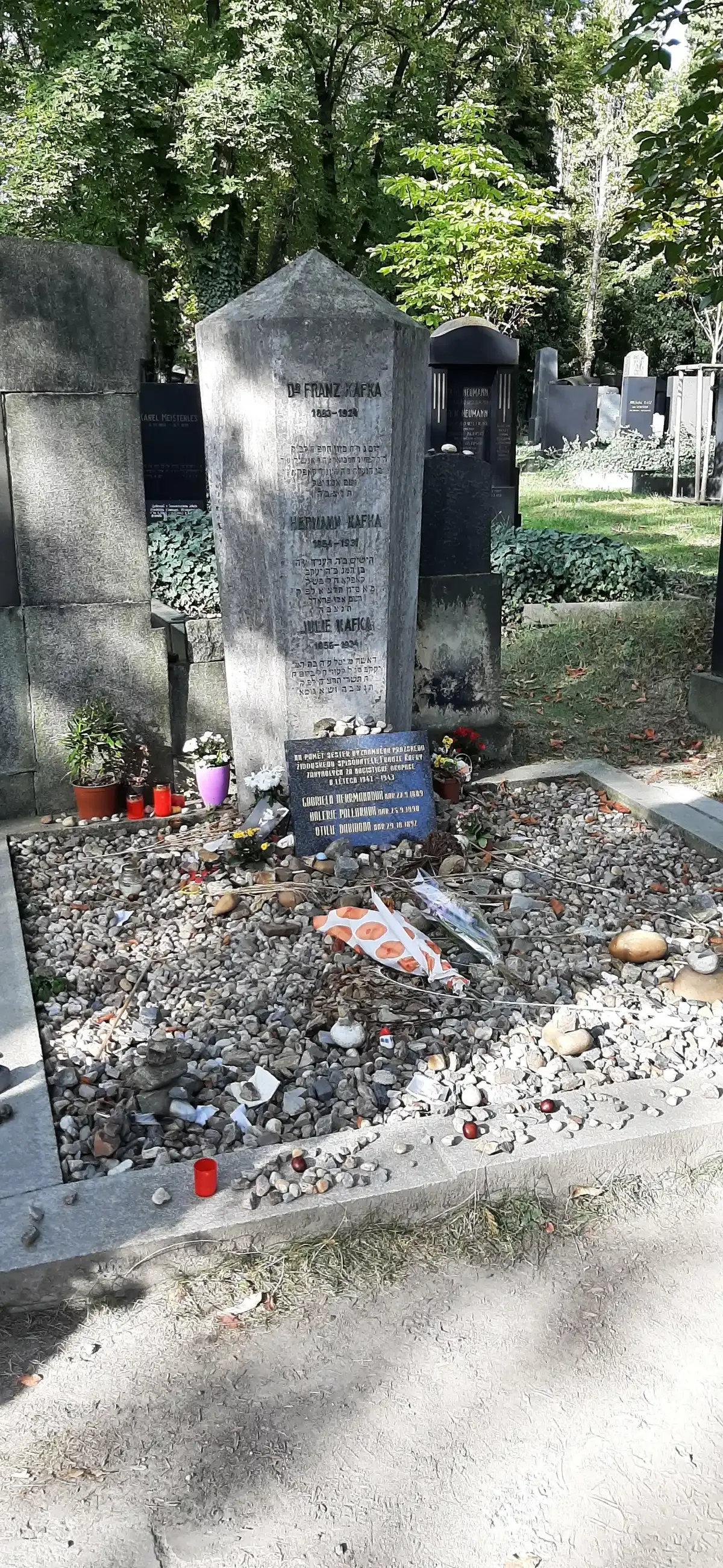
The grave of Franz Kafka at the New Jewish Cemetery. Photo: Jan_Polák, CC BY-SA 4.0, via Wikimedia Commons
Tours That Pass the Statue
The statue stands on open street, so no tour ticket is needed to see it. These walks cover the quarter around it.
The Walk That Ends Beside It
The tour to pick if you want the statue built into a full visit of the quarter is the Jewish Quarter Tour with Tickets, a 2.5-hour guided walk by Get Prague Guide priced at $74 per person. It enters the Maisel, Pinkas, Spanish and Old-New synagogues and the Old Jewish Cemetery, and the Spanish Synagogue stop puts you on Dušní street directly beside the monument. The listing does not state a group size limit, and hotel pick-up is not part of it. Free cancellation applies up to 24 hours before the start.
Also in the quarter is the Jewish Quarter and Museum Tour, a private 3-hour walk by Prague Articulate from $81 per person, listing the Spanish Synagogue among six sites entered, with a 25 euro entrance fee included. The Jewish Quarter Ticket is the self-guided option at $51, valid 1 day, covering the same four synagogues, the cemetery and the Robert Guttmann Gallery.
Cheaper Walks Through the Same Streets
If you only want the statue and the streets around it, the exteriors tours cost a fraction. The Old Town and Jewish Quarter Walking Tour runs 1.5 hours for $22 per person and passes the quarter's synagogues from the outside, with no interior entrances, so you do not go into the Spanish Synagogue. The Small Group Jewish Quarter Walk runs 2.5 hours for $21.74 per person in groups of up to 8 and holds a 5.0 rating from 250 reviews.
The 2-Hour Jewish Quarter Tour from Guides&Tours costs $28.60 per person for groups of up to 5 and starts at the Old Town Hall. The Old Town, New Town and Jewish Quarter Tour covers more ground for $30.89 per person in groups of up to 20. For a private option, the Private Jewish Quarter Tour costs $165.89 per person for 3 hours with the entrance fee included, and the Private Synagogues and Jewish Quarter Tour is $189 per group of up to 2 with hotel pick-up. None of the walks on this list include food, and none need a ticket for the statue itself, which is free on open street.
Kafka Statue Prague: Questions
Why is there a Kafka statue in Prague?
Kafka was born in the city on 3 July 1883, studied on Old Town Square, earned his law doctorate in 1906 and died in 1924 aged 40. Jaroslav Róna's bronze monument, dated 2003, marks that connection on the corner of Dušní and Vězeňská in Josefov. Guided Jewish Quarter tours in Prague cover the quarter around the spot.
What does the Kafka statue show?
It shows Kafka riding on the shoulders of a headless figure, an image drawn from his 1912 story Description of a Struggle. The work is bronze and 375 cm tall per the sculptor's page. You can read the full description on this site's Kafka statue guide.
Where is the Franz Kafka statue in Prague?
It stands at Dušní and Vězeňská in Josefov, between the Spanish Synagogue and the Church of the Holy Spirit. The nearest major public transport stop is Staroměstská, on Metro Line A and tram lines 17 and 18. The Prague Jewish Quarter map shows it in context with the rest of the quarter.
Is the Kafka statue free to visit?
Yes. It is a public monument on an open street corner, with no ticket, gate or opening hours. The Jewish Quarter Ticket at $51 is only needed for the museum sites nearby, such as the Spanish Synagogue and the Old Jewish Cemetery, not for the statue itself.
Where is Kafka buried in Prague?
In the New Jewish Cemetery in Žižkov, at Izraelská 1, Prague 3, where he was buried on 11 June 1924. His tombstone was designed by architect Leopold Ehrmann. Admission is free. Full hours and closed days are on this page's grave section.
Is the New Jewish Cemetery open every day?
No. It opens Sunday to Thursday, 9:00 to 17:00 from April to October and 9:00 to 16:00 from November to March, and on Fridays 9:00 to 14:00. It is closed on Saturdays and Jewish holidays, like the Jewish Museum Prague sites in Josefov.